The Democratic Center is a far-right Colombian political party formed by former President Alvaro Uribe to secure the continuity of his political legacy. The party is in opposition to the “coalition of national unity” led by President Juan Manuel Santos.
As one of the newest members on Colombia’s political stage, the party still has a way to go to prove itself as a stable political force.
However, as a coalition it rides upon the momentum of well-established and influential political leadership by its leader, Uribe, whose political legacy is praised by a large minority of Colombian voters.
The shaping of this legacy of booming economic growth and military victories over leftist armed groups like the FARC and ELN began at the beginning of this century, when Uribe challenged the opposition Liberal Party leadership in the bid for the 2002 elections.
Uribe / Colombia First
Until 2002, Colombia’s politics were dominated by two parties, with the pendulum of power passing control back and forth between the Bogota-based Conservative and the Liberal parties. Regional parties had previously tried to win seats in Congress, but with little to no success.
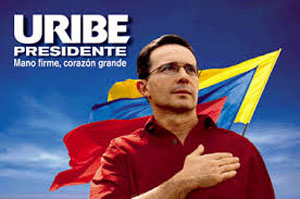
Uribe 2002 election poster
Uribe — then a former governor from the economically powerful Antioquia state — and a number of loyalists broke with the Liberal Party to found Colombia First. The party was Uribe’s formal endorser during the 2002 campaign, but has not taken part in elections since then.
Around the same time, a patchwork of locally-endorsed parties from all over the country formed to take part in the Congressional elections also held in 2002. Both the Liberal and Conservative Party lost a great number of seats to the new-wave candidates in those elections.
The vote, however, was marred by voter intimidation and coercion of candidate officials by paramilitary groups who were active in the same regions as the candidate senators and representatives.
The AUC boss at one point claimed to have one third of Congress in the pocket. Dozens of these congressmen, including Uribe’s cousin, were convicted and imprisoned.
Uribe president

Francisco Santos (L) and Alvaro Uribe
The presidential vote held later in 2002 brought the former mayor of Medellin and governor of Antioquia to the country’s highest office. He chose First Colombia president Francisco Santos to be his vice president.
Uribe and his coalition of mini-parties broke the old two-party hegemony, ushering in a new period of coalition governments.
The Conservative Party did join the coalition while the liberals again took seat in the opposition benches.
More than just breaking the pattern of governance, the electoral revolution also greatly damaged the Liberal Party.
Traditional Bogota Liberal elite politicians like Juan Manuel Santos and German Vargas left with Uribe. The electoral drain at the elections cost the Liberals more than half their seats in the Senate.
The U Party, Uribe’s party

U Party founders Juan Manuel Santos (L) and Oscar Ivan Zuluaga
Santos and businessman-turned-Senator Oscar Ivan Zuluaga formed the U Party in 2005 as a platform to provide less fragmented and crime-ridden congressional support for Uribe’s presidential bid in the 2006 elections.
Following his reelection, Uribe named Santos Defense Minister and Zuluaga Finance Minister.
With the clear support of Uribe, Santos used the U Party political machine for his successful 2010 presidential campaign. With a discourse stressing he would continue Uribe’s policies and the newly-found U Party being the largest in Congress, Santos took office on August 7, 2010.
The betrayal
One of the biggest warning signs of a schism was the fact that, following years of fighting with the high court over his allies’ ties to paramilitary groups, the Supreme Court refused to pick a Prosecutor General from a shortlist handpicked by the president. Before the issue was resolved, Uribe left office.
When Santos took office, he immediately submitted his own Prosecutor General shortlist. The court then picked Viviane Morales, a long-time political enemy of Uribe, and indictments over paramilitary ties, abuse of power, and corruption began arriving at Uribe loyalists of the highest order.
Citing the creation of a “coalition of national unity,” Santos invited Uribe’s former Liberal Party to the coalition and appointed several known political enemies of Uribe to his cabinet.
Uribe Democratic Center
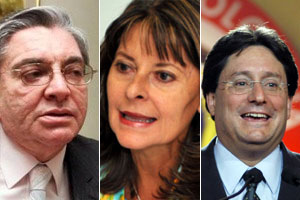
Fabio Valencia (L), Marta Lucia Ramirez (C) and Francisco Santos.
Having lost control over the government and Congress, and facing a hostile prosecution, Uribe founded the political movement that would later become the Democratic Center with senior Conservative Party politician Marta Lucia Ramirez, his former vice president Francisco Santos (a cousin of the president), and controversial former Interior Minister Fabio Valencia. The party was officially born on January 20th, 2013.
It became clear from the outset that this wasn’t just another voice on Colombia’s political stage, but a voice dedicated to opposing the Santos administration and his “coalition of national unity.”
The very first convention as an official party was focused on rejecting Santos’ then consideration of a ceasefire with Colombia’s rebel groups and urging the administration to reject an International Court of Justice ruling regarding sea territory off Colombia’s shores.
First elections
In the 2014 elections, the party displayed a great deal of success, coming away from the elections with almost 15% of the common vote, 19 seats in the senate and 12 seats in the House of Representatives.
The presidential elections later in the same year saw the party’s presidential candidate, former U Party founder Zuluaga, give incumbent Santos a bit of a scare, winning the first round and garnering 45% of the second-round vote. This set the party up as a force to be reckoned with in Colombia’s political scene. The combined legacy of the party’s leading elites and on-the-ground success validated the efficacy of the Democratic Center.
Decline and fall
The party took a turn for the worse when the Supreme Court formally launched an investigation into the party’s founder and de facto leader, Alvaro Uribe.
Initially, Uribe falsely accused leftist Senator Ivan Cepeda of bribing witnesses.
The Supreme Court, however, absolved Cepeda of the charges and found enough evidence to investigate Uribe.
In an attempt to evade the Supreme Court’s investigation of him, Uribe resigned from the Senate in 2020, prompting the case to be forwarded to a lower court instead.
Uribe was finally sentenced to 12 years in prison for using fraud and bribery to try to frustrate investigations into his family’s alleged ties to paramilitary groups on the first of August, 2025.
In October of the same year, however, a Bogota appeals court overturned the decision and ruled that the prosecution failed to prove that Uribe led a criminal conspiracy.
This entire ordeal has devastated the reputation of the Democratic Center.
Combined with the highly unpopular presidency of CD member Ivan Duque between 2018 and 2022, this led to the first left-wing government of Colombia and the marginalization of the far-right in Congress.
Another devastating blow for the party was the assassination of Miguel Uribe (not related) in June 2025.
Miguel Uribe was the party’s presidential pre-candidate and the former president’s successor. Uribe succumbed to his wounds in August 2025.
One of the party’s main candidates, Maria Fernanda Cabal, left the party in January 2026 after months of disagreement with the party’s leadership, fragmenting the party.
Related posts: