
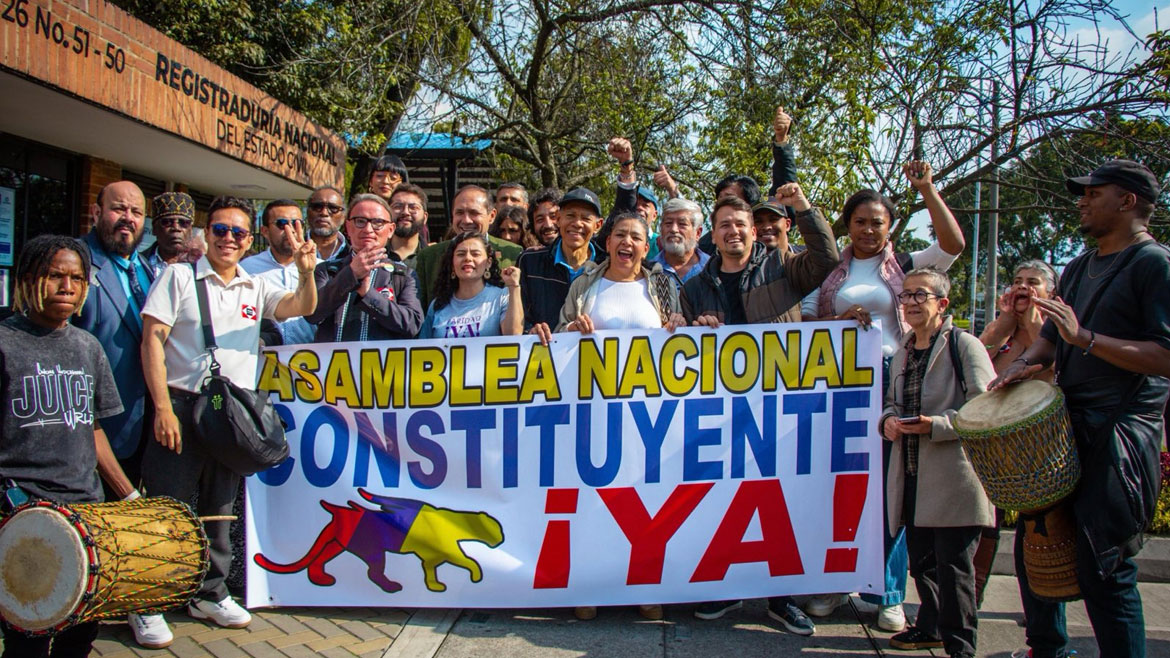

Colombia’s President Gustavo Petro and many of his followers want to organize a constituent assembly to overcome what they call a “structural institutional blockade” of popular reforms.
In a post on social media platform Twitter, Petro celebrated the formal registration of the committee that will seek popular support for the process to overhaul Colombia’s 1991 Constitution.
“The people must not allow their power to transform Colombia and move forward to be taken away,” the president said after his followers registered their so-called Promotional Committee with the National Registry.
The promotional committee seeks to collect the support of more than 8 million voters to convince the incoming Congress to organize the election of a constituent assembly after next year’s presidential elections.
The committee also created a proposed bill “invoking a Constituent Assembly,” which presumably will be presented before Congress by members of the government coalition.
According to the bill proposal, the constituent assembly seeks to address “the unfulfilled promises of democracy” made during the creation of the 1991 Constitution.
These unfulfilled promises and the institutional blockades are mainly due to Colombia’s adoption of the presidential system, the document said.
In presidential systems, the people elect members of Congress and the president in separate elections.
This system gives a president a lot of power compared to a prime minister in a parliamentary system, but tends to lead to institutional blockades when the majority in Congress opposes the president.
In Colombia, Congress has additionally become notorious for failing to legislate on people’s fundamental rights in violations of court orders that in some cases last decades.
According to the bill proposal, this has led to a failure to effectively implement the constitution and has contributed to ongoing violence and armed conflict, an must be corrected after exploring possibilities of a hybrid system that incorporates the best of presidential and parliamentary systems.
The bill additionally seeks the effective implementation of many of the promises made in the 2016 peace deal between the government and the FARC, such as decentralized power, rural reform, and women’s and minority rights.
Last but not least, the bill wants the constitution to help authorities effectively combat rampant corruption, and resist state capture by elites and organized crime.
The convening of a National Constituent Assembly is justified as an exceptional democratic mechanism that allows the sovereign people to take back control of their constitutional destiny when ordinary channels are obstructed. The aim is to deepen participatory democracy, empowering citizens to decide directly whether they want to equip themselves with a new institutional architecture in line with their needs in the 21st century. Indeed, the proposal to convene a Constituent Assembly is put forward without hidden agendas or anti-democratic intentions, but rather as an autonomous and legitimate process to transform the country and provide it with institutions in line with current needs, overcoming provisions from 1991 that have fallen behind or have been used to hinder social progress.
Constituent Assembly bill proposal
The initiative is opposed by Colombia’s traditional parties that have previously blocked legislation that would allow the implementation of the 2016 peace deal and reform proposals by the country’s first leftist president.

