

Perhaps one of the most authentic ways you can connect with your hometown is by taking the train; Bogota is no exception.
Despite the city’s infrastructure shifting to accommodate an increasing number of cars within its confines, the old Sabana Train railway, which connects the capital to nearby provinces in Cundinamarca, still stands.
Awaiting the rails
“I have high expectations for this trip, since I’ve never traveled by train before. I wasn’t expecting to see so many people here, foreigners and resident families alike. Guess it’s that popular,” says Andrea Sanchez, a 21-year-old first-time traveler.
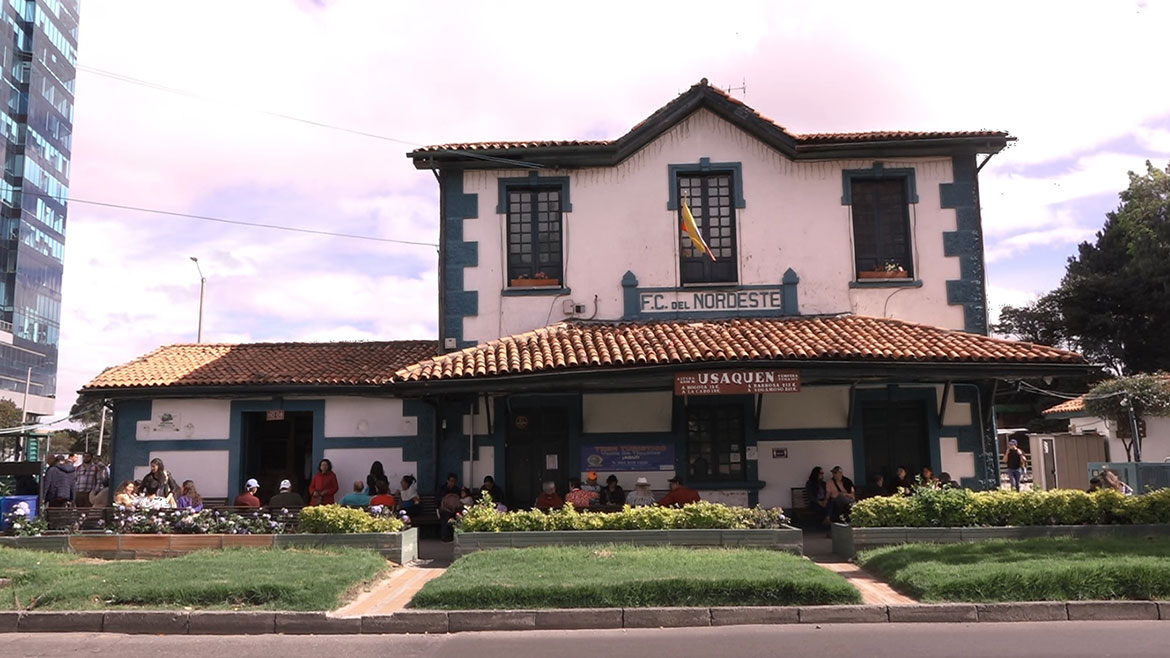
Sanchez looks around at the black-and white photographs and branded tin plates hanging on the walls of the colonial-style Usaquén Station as she pays for the $21.25 (COP $85.000) train tickets.
It shouldn’t take long for the Sabana Train to arrive. It departs from a station adjacent to the Gran Estación mall in the Center of Bogota, and travels to the Northeast.
Although this journey would take much longer by car, the train manages to reach its stop in approximately 20 minutes thanks to its dedicated infrastructure that bypasses the city’s traffic jams.
Certainly, the old railways manage to carry out swift trips more than 150 years after their construction.
The history of the Sabana train
The Bogota railway system dates back to 1865, when engineers Indalecio Liévano and Juan Nepomuceno Gonzales repurposed an old pathway French cartographer Antoine Poncet had mapped out in 1848.
Ideally, the railway system would connect the Colombian capital to the Magdalena River near the Salgar Port. Although the project faced a few setbacks, by 1889 the railway construction reached the town of Facatativá.
As the 20th century progressed, the railway system expanded its routes toward Girardot and Puerto Salgar. In 1921, the Cundinamarca Railway Company was established, and it finished the project once the last tracks reached the Magdalena River in 1925.
That same year, the network was spliced with the Girardot Railway, increasing coverage across the Cundinamarca region.
The system was finally integrated into the Central Division of National Railways, making travel easier across the country.
Simultaneously, as the railway system gained popularity, the Cundinamarca Railway Company ordered the construction of a new central station to receive trains from outlying towns into Bogota. To achieve this, the company appointed designer Mariano Santamaría and engineer William Lidstone to build what would become the Sabana Station in Los Mártires at the heart of the city.
Many smaller spots would pop up around this time in nearby localities to capitalize on the train-traveling boom. However, after this practice reached its peak in the mid-20th century, the railway network gradually deteriorated as local governments started investing in car roads as the primary form of transportation.
In the following decades, most railways were abandoned until the early 90s, when the tracks from Center-North Bogota to Zipaquirá were transformed into a cultural tourist attraction known today as Turistren, which installed their offices in the Usaquén Station.
The Sabana Train
Once the train, made up of boxy red and blue carriages, stops at the Usaquén Station, Andrea Sanchez, much like every other waiting passenger, rushes to grab a seat. The train’s interior remains old-timey, featuring metallic seats, old grey cushions, and wooden tables to take a snack at.
Sanchez sits here and waves to the man carrying a small cart. He describes all the traditional snacks he offers, including buñuelos, almojábanas, and arépas, as well as beverages such as hot chocolate and tinto.
“I think this whole place is comfortable. You can tell the train’s structure is quite old and features some dated elements, like these sheer lace curtains. Nonetheless, it seems well preserved, especially the dining areas,” notes Sánchez as she sips her hot chocolate.
The Sabana Train rushes through the northern countryside, passing thick forests, livestock, and eroded mountains. Eventually, the train crosses into the town of Chía and La Caro Station, another 20th-century spot that once greeted hundreds of travelers each day. The train then gets lost among dozens of small brick houses that make up the colonial heart of Chía.
Finally, the old locomotive reaches its end stop: the Zipaquirá Station, which stands out due to its French neoclassical architecture from the 1920s. White-stoned walls cover up symmetrical balconies, engraved wooden doors, and local artwork pieces. In other words, it’s a tourist magnet.
Sánchez disembarks. “Now that I’m here, I’d better check out the local artisan market and get some lunch too. I think I’ll also stick around for the banda papayera concert next to the station; the ladies over here are having fun singing along. What can I say? My expectations were met.”
Even after all these years, there’s a certain charm in following the iron railways to see how far they’ll take you.
